ENABLE Project- Presentation and kick off Meeting

SIRIUS is starting a new European project called ENABLE, focused on “enabling school integration of migrant and refugee children through social and emotional learning interventions to address psychosocial trauma”and implemented by 7 partners from 5 European countries (France, Belgium, Italy, Turkey and Greece). On the 12th and 13th of January SIRIUS met with the project partners in Pau (France) for the Kick off Meeting. 


The ENABLE Project

Migration and especially forced displacement and refugee experiences are associated with extreme psychosocial trauma considering the conditions under which migrants and refugees have to leave their countries, which is even more severe when it comes to children who are still in the sensitive period of development. Schools can be important settings to foster the wellbeing of all students, and particularly that of Migrant, Refugee and Displaced Children (MRDC) who may have had traumatic experiences before leaving their homes, during the journey or while settling in a new community or country. 

In recent years, the key role that education plays in treating psychosocial trauma among MRDC is increasingly recognized as school institutions can stimulate resilience and cultivate learners’ social and emotional development, thus helping build self-confidence and emotional regulation skills, while teaching children to create relationships based on trust with others.

ENABLE’s key objective is to promote the social and emotional development of Migrant, Refugee and Displaced Children (MRDC) through culturally sensitive, school-based interventions designed to deal with the negative effects of psychosocial trauma. The project’s specific objectives are to:

  1.  enhance the capacity of primary & secondary schools to effectively deal with cases of psychological trauma by developing first-level treatment and response mechanisms, protocols and tools
  2.  build the capacity of primary & secondary education teachers to stimulate the social and emotional development of MRDC in the school environment
  3. raise the awareness of educational institutions, relevant stakeholders and decision makers about the= importance of strengthening their policy framework on psychosocial trauma treatment for MRDC.

Expected result of the project 

  • A mapping matrix on effective psychosocial trauma practices focusing on the needs of MRD children in schools.
  • A defined Trauma-informed Teacher/Educator Profile (incl. training needs).
  • A validated Online Training Course on Trauma-Informed Teaching in primary and secondary schools comprising horizontal and specialised modules for i) School teachers & ii) School heads/managers.
  • Training workshops with the participation of both teachers and principals in primary and secondary schools.
  • An integrated Trauma-Informed School Policy for MRD children in the form of a Toolkit for primary and secondary school managers, key actors and decision makers at local and national level.
  • Awareness raising campaign through website, social media, printed and electronic material etc. and through events, such as advocacy/lobbying meetings, info days and a final conference.
Welcoming Third-Country Nationals in Higher Education in Europe – Lifelong Learning Week 2022

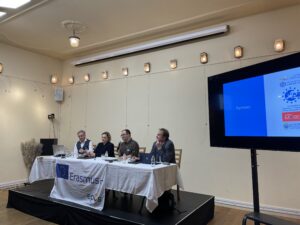
As part of the LLLWeek, SIRIUS joined the MAXIPac closing event which took place the 1st of December in Brussels.

The Lisbon Recognition Convention says that all countries should develop procedures to assess whether refugees and displaced persons fulfil the relevant requirements for access to higher education or to employment activities, even in cases in which the qualifications cannot be proven through documentary evidence. Regardless of that, in reality this letter has not been applied in most cases, and to this day third-country nationals often face a lot of challenges in the recognition of their requalifications. The MAXIPac project aims to fill this gap, by closely working with universities and academics to create and implement a uniform procedure to valorise previously acquired competences of third-country nationals by universities. 

As part of the final event, Sevak Khachatryan, SIRIUS co-chair, participated in the panel discussion “How can universities, non-governmental organisations and policy-makers contribute to more inclusive European higher education?”. He highlighted the responsibility of universities in the inclusion of TCNs in higher education, as well as the importance of including migrants and refugee students in the development of these types of projects, acknowledging their agency and right to participate in processes that directly affect to their future. 


#EURegionsWeek Youth participation and democracy: a quick overview

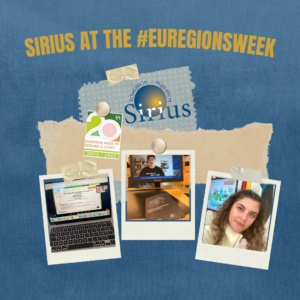
The European Week of Regions and Cities is a one-week-long event organised by the EU Committee of the Regions that promotes the sharing of good practices and ideas for a greener, more inclusive and cohesive Europe. Sirius, represented by Kejsi Hodo, Communications Intern, took part in two workshops about youth participation and empowerment. The main themes dealt with were the characteristics of youth participation, the reasons behind its decrease and the ways to improve the situation.

First of all, it is important to stress the fact that the youth participation rate registered last year was at 87%[1]. Thus, it is clear that the participation degree is quite high, but to understand what it means, it is necessary to further unpack the meaning of active citizenship. As a matter of fact, apart from voting, young people express their political views by signing petitions (often online), posting on social media, using hashtags to bring awareness and other ways which are not considered to be traditional participatory practices[2]. This is very important when analysing youth behaviour in politics, because it brings to light the generational differences in dealing with political and/or social issues. So, what does active citizenship mean in 2022? Online platforms, social media, petitions etc play a crucial role when it comes to youth and democracy. In addition, one of the fundamental aspects about it are the different means of getting information, as young people use mainly social media and websites, which indicates the influence that online platforms have on politics.

However, why is it that young people vote less and less? In general, 46% of the participants of the Eurobarometer survey report they have voted. Thus, voting is still the most chosen way to express one’s political preferences, but there are many drawbacks. Among the three of the most reported barriers to voting, there are: not being old enough, not being interested and lack of trust in politicians[3]. During the workshops, we addressed the reasons behind the decrease in the “traditional” participatory practices and how to boost young people participation. The most agreed on practice was the establishment of a strong connection between politicians and youth, to improve trust and empower young minds to make a difference. However, one crucial aspect to reflect on is economic security, as people in problematic situations are not able to be active citizens just because of their circumstances. Lastly, another underprivileged category is that of the second-generation migrants, who are often disregarded when it comes to decision-making processes and cannot vote in many EU countries.

In short, young people are generally active citizens who are accustomed to many non-conventional participatory practices, such as online petitions, social media posts and so on. However, when it comes to voting, it is critical to understand the reasons behind the decrease in the participation level and try to come up with ways to better engage the youth. Having more direct contact with decision-makers, ensuring economic security and inclusion are three pillars of youth participation. At the end, young people are not only the future, but they are also the present of our socities. Hence, their involvement in politics should be a priority and an occasion to reflect on the necessity of accepting differences and taking advantage of each other’s experiences towards an effective transgenerational and inclusive dialogue.

Written by: Kejsi Hodo, Communications Intern at SIRIUS Network

[1] Flash Eurobarometer European Parliament Youth Survey September 2021

[2] ibidem

[3] ibidem

YMCAC: drawing conclusions and keeping an eye on the future

Now that a month has passed since the end of the UYD, we will go deeper into Sirius’ training, Young Migrants Can Achieve Change (YMCAC). We will explain the activities of YMCAC, look into the results obtained and see what the future holds for us.

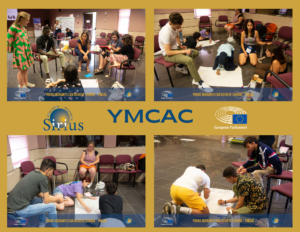
The first day of the YMCAC training was mainly about getting to know each other and the content and terms of the training. This was done through icebreakers and the creation of an expectations tree, which the participants had the opportunity to revise and reflect on. Afterwards, we discussed about the Sustainable Development Goals (SDGs). We explored them by completing a treasure hunt to associate each SDG with its targets. Furthermore, the participants connected the SDGs to the current world, their own lived experiences and environment. The activity was enriching, as it enabled them to gain a better understanding of their importance and the role they play in everybody’s lives. Next, we focused on the EU institutions. The participants learnt about the EU bodies and decision-making process through a quiz and a roleplay game. These activities helped them go deeper into the policy-making mechanism within the EU and the decisive role of the activists in influencing policy through advocacy campaigns.

The second part of the training had a more practical setting. Firstly, the joint session with Young European Federalists (JEF) and European Youth Card Association (EYCA) gave everyone the opportunity to brainstorm about discriminating practices in society and how to overcome them. Thus, we divided the participants into groups and they created their inclusive society, implementing their view on what inclusivity means. Each group focused on a building, for instance the townhall, the school or even the nightclub, and the final result was the idyllic, inclusive town. We then focused on advocacy and the role of activists in the EU decision-making process. We used some interesting tools to explain how the creation of campaigns works, namely a few online and offline campaign examples and a mock campaign (titled Think Pink!). So, the participants created their own mock campaign to go through all of the steps of actually creating an advocacy campaign, both stakeholder and section-wise. They also presented their mock campaigns to each other and exchanged feedback on them. Overall, this was an entertaining moment in which participants put all their imagination into use and came up with the funniest campaigns, and, at the same time, really understood how to make a campaign from scratch. Therefore, in the next session, they started to think about the topic of their real campaign, taking into account the elements learned during the mock campaign session. Lastly, the final days were mainly about drafting the advocacy campaigns and presenting them in order to receive comments from everyone through a World Café activity, which gave the participants the opportunity to express their ideas and help each other.

In conclusion, through the YMCAC training, the participants had the opportunity to learn in depth about the SDGs, the decision-making process of the EU and advocacy. They also drafted their own campaign, which they will continue to implement in their local areas in the coming months. And this is not the end! YMCAC still goes on: Sirius will help the participants with their advocacy campaigns by giving technical and financial support, and the participants will be engaged in their local communities until March. Afterwards, Sirius will draft policy recommendations based on the feedback and results of the campaigns. In addition, the participants will present their work during the final YMCAC event, in April 2023. The event will also host Members of the European Parliament, in the hopes that our young change-makers will bring awareness to topics dear to them and influence the MEPs’ agendas for the 2024 elections.

Stay tuned for more news on the advocacy campaigns and the together.eu platform!

*This content reflects only the author’s view and the European Parliament is not responsible for any use that may be made of the information it contains.

Working Group Meeting on Anti-racist Education

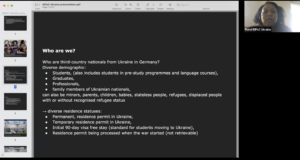
This week SIRIUS Network, on Behalf of ENAR, has coordinated a Working Group on Access to Education for migrants and refugees of color within the EU. The focus on this meeting was the access to higher education of third national refugees fleeing from Ukraine.

We had as a speaker BIPoC Ukraine and Friends in Germany, a self-organized group which offers assistance and advice to African international students who fled from Ukraine and leads advocacy actions. We had participants from different organizations across Europe and also observers from the European Commission. During this meeting we had the opportunity to report on the situations of refugee international students in different Member States, and we had a fruitful discussion.  As a result of the conversionation, the group has agreed on the next actions of our Working Group. 


UYD 2022 – Young Migrants Can Achieve Change

This past week SIRIUS took part in the University of Youth and Development, which is an event that aims at improving youth participation, intercultural dialogue and global citizenship. It gathers hundreds of young people, youth workers, experts from the field, institutional representatives and decision makers, all working towards exploring the concept of global education through a non-formal approach. This year, the event was held in Mollina (Malaga, Spain), in the Euro-Latin-American Youth Centre (CEULAJ).

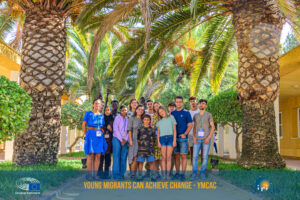
We invited 10 young migrants and refugees to step into roles as activists in their own communities from our members organizations Superacció, Olive, Multikulti and Unleash Refugee Potential. We were thrilled about their personal and professional development where they showed us that the right environment and a minimum of support can transform them into serious campaigners for issues both close to their heart and vital for the promotion of education and inclusion. 

The training at UYD is part of a European Parliament funded SIRIUS project, ‘Young Migrants Can Achieve Change – YMCAC’ that brings together young people to enable them to raise their voices and put forward their instances in order to influence policy decisions, even if they cannot vote for the European Parliament.

Our next phase in this project is supporting our participants in finishing and implementing their campaigns in their local communities. Afterwards, they will be able to present the results of their work to Sirius and also to MEPs. 

With a final step of engagement and empowerment- where we look forward to inviting our young participants, Members of European Parliament and others to the final event, which will take place at the end of April 2023.

We wish to thank the UYD, the Council of Europe, the European Parliament and the North-South Center – and, particularly, the young people we met and enjoyed a week with – for showing us that collaboration, good will, hard work and passion can bring change. 


SIRIUS at the University on Youth and Development

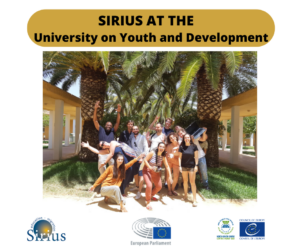
This upcoming September, between the 11th and the 18th, SIRIUS Network will be one of the organisations hosting an activity under the framework of the University on Youth and Development from the Council of Europe.  

This is going to be the 21st edition of the UYD, which is an international youth event organised by the North-South Centre of the Council of Europe, where a number of youth-led and youth-oriented organisations have the possibility to run their own activities (trainings, seminars, board meetings, etc.) within a dynamic and participatory context which encourages networking, cooperation and peer-to-peer education. 

Since 2000 the UYD represents an international hub for meetings, youth advocacy and exchange of good practices. It gathers, for one week, hundreds of young people, youth workers, decision makers, experts from the field and institutional representatives, providing them all with a space to meet, debate, build their capacities and cooperate on youth policy issues. [https://bit.ly/3b4uVJz]. 

SIRIUS will organize an activity that will include young migrants and refugees (ages 16-25) that have arrived at the EU in different circumstances, and that currently are in different stages of their life. We will provide them knowledge on policy and more specifically on advocacy, and how to create advocacy campaigns to claim their rights and what they would like to see in the EU for their lives to be better.   

We want to thank the North-South Center for the opportunity of hosting our activity in the context of the UYD, as we believe that it’s a great place for our trainees to learn and to make good relationships with people around Europe and beyond.  

As SIRIUS, we will continue with our work on including migrants and refugees into the educational systems in the best way possible, and for them to have a quality education no matter where they go in Europe.  

Lifelong learning Laboratory – learning how to do our job better

On the 30th and 31st of May, SIRIUS attended the Lifelong Learning Laboratory held by the Lifelong Learning Platform. The Laboratory focused on Lifelong Learning entitlements for the Future for Europe and brought a diverse audience together to further the European agenda by discussing and understanding decision-making processes in education and training.  

 The first day hosted a panel with six experts with experience in promoting, implementing and addressing the challenges and barriers to implementation of EU education agenda. The topic of mobility was raised in all levels of education and for educators too. Barriers identified were that large organisations and companies need to be onboarded to the benefits of mobility programs and people who feel that a mobility is not for them due to social and educational marginalization. Another topic raised was how to help the transfer of learning from organisation to organisation, policy-making systems to policy-making systems across Europe. It was noted here that organisations, schools and others need autonomy in order to be able to have freedom to try out new ideas, pilots, programs.  

The second day was spent understanding the French lifelong learning agenda and the perspectives shared demonstrated the commitment of the French Government to the achievement of entitlements to all and particularly in the higher Education and VET a-domain.  

Active workshop sessions were very fruitful for SIRIUS and we were thrilled to collaborate in workshops to brainstorm how to co-create a world where those entitlements are felt and experienced by all in Europe. Something that is incredibly important for migrant education.   

We would like to thank LLLP, the speakers and all the attendees for providing us such a rich experience in how we can advocate better at the EU level and support our members at the national level too. Looking forward to next year!